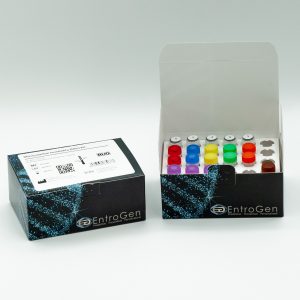
RAS c.59/117 Mutation Detection Kit
Cat Number: RASX-RT50
The RAS c.59/117 Mutation Detection Kit is a rapid, real-time PCR assay for detection of KRAS c.59, NRAS c.59/117 somatic mutations used to help identify mCRC patients unlikely to benefit from EGFR-targeted therapy, enabling more informed and personalized treatment decisions
- Below 1% Limit of Detection
- 50 tests per kit
- 2-hour turnaround time
- Works with FFPE
- 3 Reactions per sample
- For research use (RUO) in the U.S
- For in vitro diagnostic use (IVD) in the European Union
The RAS c.59/117 Mutation Detection Kit is an add-on real-time PCR assay that detects rare somatic mutations in KRAS codon 59 and NRAS codon 59/117, complementing the commonly targeted mutations identified by the KRAS-RT50, NRAS-RT50, or KRBR-RT50 kits.
Designed exclusively for DNA isolated from formalin-fixed paraffin-embedded (FFPE) tissue, this kit enables comprehensive RAS mutation profiling in metastatic colorectal cancer samples that test negative for the more common mutations, ensuring more informed treatment decision-making.
Below is a list of mutations detected by this kit:
| Gene | Exon | aa change | nt change | Cosmic ID |
| KRAS | 3 | A59T | c.175G>A | 546 |
| A59E | c.176C>A | 547 | ||
| A59G | c.176c>G | 28518 | ||
| NRAS | 3 | A59T | c.175G>A | 578 |
| A59D | c.176C>A | 253327 | ||
| 4 | K117R | c.350A>G | 4696722 |


The RAS c.59/117 Mutation Detection Kit follows a simple and easy to use process. It can be completed in 2 hours and follows a far less complicated process.
EntroGenʼs RAS c.59/117 Mutation Detection Kit requires a real-time PCR instrument capable of detecting VIC and FAM fluorescent probes.
This test includes reagents required for PCR amplification/detection, as well as validated reaction controls.
Columns and reagents for DNA isolation are not included.


Download Certificate of Analysis